
Software for laying hen farms: what it should measure and how to choose
Updated: November 26, 2026
Short answer: Good software for a laying hen farm does more than store data: it compares every flock against its breed curve, week by week of age, and shows you egg production, mortality by tier, feed conversion and feed cost per egg. Farms today take one of four routes (spreadsheets, the controller manufacturer's software, generic management software, or a platform built for layers). Choose based on how easy it is to record data in the real routine of the poultry house, and on whether you can export everything whenever you want.
The four solutions farms use today
Almost every laying hen farm starts the same way: the data already exists, but it lives on paper, in Excel and in the controllers of each house. What changes is how it gets brought together and what is done with it.
- Excel and spreadsheets. Flexible and cheap, and every farm adapts it in its own way. But it depends on someone typing, a cell formula can break without anyone noticing, it never alerts you, and comparing against the breed curve is manual work. It usually ends up as one file per house and a summary at month end.
- The controller manufacturer's software. It records what the equipment measures well (feed and water intake, egg count, climate) and comes with the installation. What it does not see is what happens outside the equipment: mortality written down by hand, egg quality from the grader, the price of each feed formula. And it usually only talks to its own equipment.
- Generic management software (ERP or general farm software). It handles inventory, purchasing and accounting. It is rarely built around layer flocks by week of age, and it rarely includes the breed curve, so production analysis ends up back in a spreadsheet.
- A platform built for laying hens. It is organized around the flock, the week of age and the breed guide. The trade-off: you need to check that it integrates with your controllers and does not force your team to change their routine.
Comparison by criterion
This is a generalization by type of solution, not a review of specific products: every product is different, so check each criterion with the vendor.
| Criterion | Excel and spreadsheets | Controller software | Generic software / ERP | Specialized platform |
|---|---|---|---|---|
| Flock and week of age | Partial (depends on how you set it up) | Partial | Partial | Yes |
| Comparison with the breed curve | Partial (you enter the curve by hand) | No | No | Yes |
| Mortality by tier | Partial | No | No | Yes |
| Feed conversion and feed cost per egg | Partial (manual calculation) | No | Partial | Yes |
| Worker data entry without changing routine | No | Partial (only what the equipment measures) | No | Yes, if it accepts a photo of the logbook |
| Integration with controllers | No | Yes (own brand only) | Partial | Yes, depending on brand |
| Egg quality from the grader | Partial | No | Partial | Yes |
| Deviation alerts | No | Partial (equipment alarms) | Partial | Yes |
| Works without controllers | Yes | No | Yes | Yes, if it has a data entry app |
| Data ownership and export | Yes | Partial | Partial | Depends: get it in writing |
Selection checklist
- Flock, not just house. Data belongs to the flock: when a house gets a new flock, the history of the previous one must not be mixed in.
- Week of age as the axis. Everything is compared at the same age, not on the same calendar date.
- Breed curve. Egg production, egg weight and feed intake against your breed's management guide and, if possible, against your own historical standard.
- Mortality by tier. If your houses have several tiers, a localized problem gets lost in the house average.
- Feed conversion by flock, calculated correctly (see the feed conversion guide).
- Feed cost per egg by formula and by week (see the feed cost guide).
- Worker data entry without changing their routine. If the software requires workers to learn a complex system, data arrives late or not at all.
- Integration with controllers and an alert when a house stops sending data.
- Egg quality from the grader: broken, cracked, dirty.
- Alerts with the house, flock and exact number, not just charts to look at.
- Data ownership and export: the data is yours and you can take all of it with you.
- It works without controllers, if any of your houses has none.
Questions to ask any vendor
- Can I see my own farm loaded before I pay?
- How does data get in from a house without a controller? And from the paper logbook?
- Which controller brands does it integrate with today, not on the roadmap?
- What happens if a house stops sending data? Do I find out that same day?
- How does it calculate feed conversion, and what does it do with days without a reading?
- Can I export all my data, in what format and whenever I want?
- Is my data used for other customers or shared with third parties?
- How long does implementation take, and do operations stop in the meantime?
Where flowkore fits
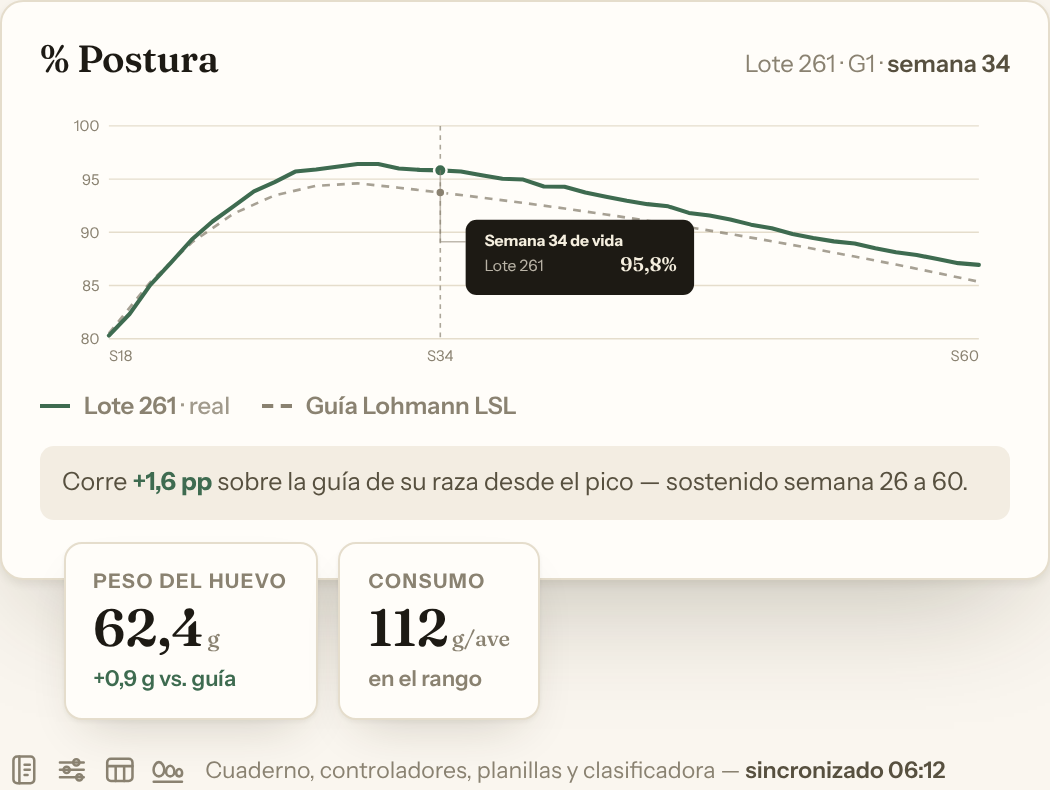
flowkore is a platform built for laying hens: it brings together the worker's logbook, the controllers of each house, spreadsheets and the egg grader, and compares every flock against its breed guide and against your own standard, week by week of age.
- Workers enter data in three taps from their phone, or take a photo of their sheet or logbook and the AI reads it, checks the totals and asks for confirmation before saving. It works even if the farm has no controllers.
- Native integration with Big Dutchman (AMACS) today; other brands are reviewed during the assessment. If a house stops sending data, an alert goes off the same day.
- Imports historical Excel spreadsheets and egg grader data, including egg quality (broken, cracked, dirty).
- Mortality by tier (up to 8 tiers), feed conversion by flock, feed cost per egg by week and by formula, and alerts by Telegram or email.
- Your data is yours, it is not shared with third parties, and we hand over a full export whenever you ask.
Today it runs on a farm with 1,593,452 hens housed and 17 active flocks across 4 breeds. What it is not: a purchasing and accounting ERP. If you need that, it sits alongside your back-office system. We start with a free assessment using your spreadsheets, a 30-day pilot in one house, and then the rest of the farm.
Frequently asked questions
What should laying hen farm software measure?
At a minimum: egg production, mortality (ideally by tier), feed and water intake, body weight and egg weight, all by flock and by week of age, compared against the breed management guide. Add feed conversion and feed cost per egg on top of that.
Is Excel enough to manage a laying hen farm?
For a small farm it can be. As you add houses and flocks, the problem is that it depends on someone typing, it does not flag deviations, and comparing against the breed curve is manual. Many farms keep it as their historical source and import those spreadsheets into a platform.
Can I use management software without controllers in my houses?
Yes, if the software has a simple way to enter data by hand. In flowkore, workers enter data from their phone in three taps, or take a photo of their sheet or logbook and the AI reads it, so it works even if the farm has no controllers at all.
What happens to my data if I stop using the software?
It should be yours and fully exportable, and it is worth getting that in writing before you sign. In flowkore your farm's data is yours, it is not shared with third parties or used for other customers, and we hand over a full export whenever you ask.
Try it with your own spreadsheets
Want to see this with your own numbers? Free assessment with your spreadsheets: send us the last few weeks' spreadsheets and we will send back your farm loaded in flowkore, with rate of lay vs. standard, mortality and feed conversion. Message us on WhatsApp or write to info@flowkore.com.