
Laying hen body weight by week of age
Updated: November 26, 2026
Short answer: A laying hen's body weight changes with age and breed. According to the management guides, at week 17 it weighs about 1,241 g in Hy-Line W-80, 1,255 g in Lohmann LSL-Lite, 1,396 g in Hy-Line Brown and 1,421 g in Lohmann Brown-Classic. By week 90 it reaches between 1,704 and 2,055 g. White hens are lighter than brown ones. To know whether your flock is on track, compare it with its breed at the same week of age.
How much it weighs by age, in short
- Week 1: between 70 and 75 g depending on the breed.
- Week 17, at the end of rearing: from 1,241 g (Hy-Line W-80) to 1,421 g (Lohmann Brown-Classic).
- Week 30, near peak lay: from 1,595 g (Hy-Line W-80) to 1,921 g (Lohmann Brown-Classic).
- Week 90: from 1,704 g (Hy-Line W-80) to 2,055 g (Lohmann Brown-Classic). After week 40, weight rises slowly.
All values are grams per bird, taken from each breed's management guide. The range the guide gives is in parentheses.
Rearing: body weight from week 1 to 17
| Week of age | Hy-Line W-80 (g) | Lohmann LSL-Lite (g) | Hy-Line Brown (g) | Lohmann Brown-Classic (g) |
|---|---|---|---|---|
| 1 | 71 (67–75) | 70 (68–72) | 71 (69–73) | 75 (73–77) |
| 2 | 131 (125–137) | 120 (116–124) | 123 (119–126) | 130 (126–134) |
| 4 | 268 (256–280) | 255 (247–263) | 274 (266–281) | 273 (265–281) |
| 6 | 432 (414–450) | 425 (412–438) | 469 (456–482) | 469 (455–483) |
| 8 | 622 (598–645) | 635 (616–654) | 687 (668–706) | 677 (657–697) |
| 10 | 812 (783–840) | 825 (800–850) | 896 (871–921) | 873 (847–899) |
| 12 | 973 (942–1,004) | 959 (930–988) | 1,076 (1,046–1,105) | 1,047 (1,016–1,078) |
| 14 | 1,097 (1,066–1,127) | 1,084 (1,051–1,117) | 1,220 (1,186–1,254) | 1,205 (1,169–1,241) |
| 16 | 1,194 (1,164–1,223) | 1,200 (1,164–1,236) | 1,340 (1,302–1,377) | 1,351 (1,310–1,392) |
| 17 | 1,241 (1,212–1,269) | 1,255 (1,217–1,293) | 1,396 (1,357–1,434) | 1,421 (1,378–1,464) |
In lay: body weight from week 18 to 90
| Week of age | Hy-Line W-80 (g) | Lohmann LSL-Lite (g) | Hy-Line Brown (g) | Lohmann Brown-Classic (g) |
|---|---|---|---|---|
| 18 | 1,287 (1,257–1,316) | 1,306 (1,267–1,345) | 1,452 (1,411–1,492) | 1,493 (1,448–1,538) |
| 20 | 1,368 (1,336–1,400) | 1,405 (1,363–1,447) | 1,568 (1,524–1,611) | 1,635 (1,586–1,684) |
| 22 | 1,433 (1,398–1,467) | 1,497 (1,452–1,542) | 1,685 (1,638–1,732) | 1,760 (1,707–1,813) |
| 24 | 1,487 (1,450–1,523) | 1,575 (1,528–1,622) | 1,789 (1,739–1,838) | 1,846 (1,791–1,901) |
| 26 | 1,533 (1,495–1,570) | 1,628 (1,579–1,677) | 1,862 (1,810–1,913) | 1,893 (1,836–1,950) |
| 30 | 1,595 (1,554–1,636) | 1,651 (1,601–1,701) | 1,918 (1,864–1,971) | 1,921 (1,863–1,979) |
| 36 | 1,639 (1,595–1,682) | 1,662 (1,612–1,712) | 1,958 (1,903–2,012) | 1,936 (1,878–1,994) |
| 40 | 1,651 (1,605–1,696) | 1,669 (1,619–1,719) | 1,976 (1,921–2,030) | 1,946 (1,888–2,004) |
| 50 | 1,663 (1,613–1,712) | 1,685 (1,634–1,736) | 1,994 (1,938–2,049) | 1,972 (1,913–2,031) |
| 60 | 1,673 (1,620–1,726) | 1,698 (1,647–1,749) | 2,003 (1,947–2,058) | 1,996 (1,936–2,056) |
| 70 | 1,683 (1,626–1,740) | 1,709 (1,658–1,760) | 2,010 (1,954–2,066) | 2,021 (1,960–2,082) |
| 80 | 1,694 (1,633–1,754) | 1,716 (1,665–1,767) | 2,016 (1,960–2,072) | 2,046 (1,985–2,107) |
| 90 | 1,704 (1,639–1,769) | 1,721 (1,669–1,773) | 2,020 (1,963–2,076) | 2,055 (1,993–2,117) |
Sources: Hy-Line W-80 Performance Guide (April 2026) and Hy-Line Brown (December 2025), Hy-Line International; Lohmann LSL-Lite Production Chart and Lohmann Brown-Classic Management Guide, Lohmann Breeders. In the Hy-Line guides, the value is the midpoint of the range the guide gives, rounded to the gram. In the Lohmann guides, the value is the average weight in its table and the range comes from another column of the same guide. The LSL-Lite guide ends at week 95.
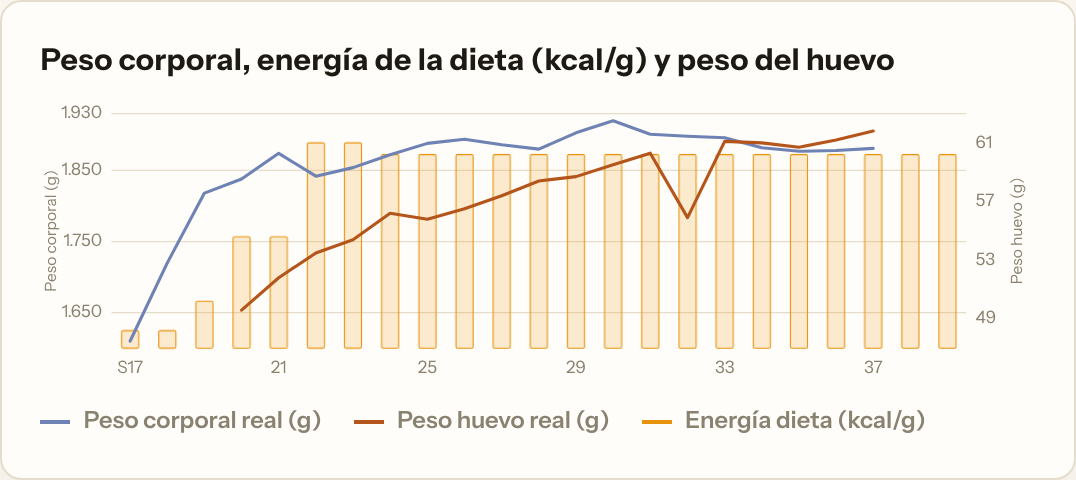
How to compare your flock's weight
- Weigh a sample of birds every week, with the same method, and record the average by house and by flock.
- Compare at the same week of age and breed. Weight is read by age, not by calendar date.
- Look at the range, not just the central value. Within the guide's range, a flock is where it is expected to be.
- Look beyond the average. Two flocks with the same average weight can have very uneven birds; that is why it is worth looking at uniformity too.
What to do if your flock's weight is off the guide
- Check the data first: that the week of age is counted correctly, that the breed entered is the right one and that the scale and sample are comparable from week to week.
- Look at the trend, not a single weighing. A flock that stays below the range for several weeks in a row is different from one that had one low weighing.
- Read it together with feed intake, rate of lay and egg weight. Body weight, what birds eat and what they lay move together.
- Pay attention to weight at the end of rearing. It is the weight at weeks 17-18, when lay begins, and it is worth discussing with your technical advisor or veterinarian if the flock arrives outside the range.
- The guide is a reference, not a diagnosis. Check management and feeding decisions with your nutritionist or veterinarian.
To know how much the flock should eat at each age, see the guide on how much a laying hen eats per day. For the cost of that feed, feed cost per egg and feed conversion. And for rate of lay against the breed guide, egg production vs breed standard.
Where flowkore fits
flowkore compares every new data point against the breed curve and the flock's history, week by week of age, and shows body weight and egg weight on the same curve. If you track weighings in Excel today, flowkore imports the spreadsheets as they are. See more in the guide to choosing software.
Frequently asked questions
How much does a laying hen weigh?
It depends on breed and age. According to the management guides, at week 30 a laying hen weighs about 1,595 g (Hy-Line W-80), 1,651 g (Lohmann LSL-Lite), 1,918 g (Hy-Line Brown) or 1,921 g (Lohmann Brown-Classic). By week 90 it reaches between 1,704 and 2,055 g.
How much does a laying hen weigh at 17 weeks?
At the end of rearing, the guides give 1,241 g for Hy-Line W-80, 1,255 g for Lohmann LSL-Lite, 1,396 g for Hy-Line Brown and 1,421 g for Lohmann Brown-Classic. Each guide also gives a range around that value.
How much does an 8-week-old pullet weigh?
According to the guides: 622 g for Hy-Line W-80, 635 g for Lohmann LSL-Lite, 687 g for Hy-Line Brown and 677 g for Lohmann Brown-Classic. These are reference values by breed; each guide's range is in the rearing table.
Does a brown hen weigh more than a white one?
According to these guides, yes. At week 30 brown hens weigh between 1,918 and 1,921 g and white hens between 1,595 and 1,651 g. The difference already shows in rearing: at week 17 brown hens are at 1,396 to 1,421 g and white hens at 1,240 to 1,255 g.
Try it with your own spreadsheets
Want to see this with your own numbers? Free assessment with your spreadsheets: send us the last few weeks' spreadsheets and we will send back your farm loaded in flowkore, with rate of lay vs. standard, mortality and feed conversion. Message us on WhatsApp or write to info@flowkore.com.