
Egg production against the breed standard: how to compare your flock properly
Updated: November 26, 2026
Short answer: Rate of lay (hen-day production) is eggs / live birds × 100, and it is compared against the breed guide by week of age, not by calendar date. One percentage point of lay equals one more egg per day for every 100 birds, or (birds / 100) × 365 eggs a year.
What to measure: rate of lay and hen-housed eggs
- Rate of lay (%) = eggs in the period / live birds / days × 100. It is the daily or weekly measure of how many hens are laying.
- Live birds = hens housed minus the flock's cumulative mortality. Do not use the controller's bird count: it can be off.
- Hen-housed eggs = cumulative eggs / hens housed. It measures how many eggs each bird that entered the house produced, including those that died: it rewards the flock that keeps birds alive and laying.
Illustrative example with made-up numbers: 10,000 hens housed, 300 cumulative deaths, 9,700 alive. A week with 61,000 eggs: 61,000 / (9,700 × 7) = 89.8% rate of lay.
Compare by week of age, not by calendar
A laying hen follows a curve with age: it rises to peak, holds, and then declines. Two flocks can be on the same calendar dates but at different ages, so there is nothing to compare. What you compare is the same week of age.
- Line up each flock by its week of age, from the start of lay.
- Compare against your breed's management guide for that week of age.
- Also compare against your own history: an earlier flock of yours, same breed and same age, says more about your houses than a general guide.
- Do not mix breeds in the same comparison without saying so: each one has its own curve.
Reference values by breed
| Breed | Rate of lay wk 30 | Wk 50 | Wk 70 | Wk 90 | Hen-housed eggs at wk 90 |
|---|---|---|---|---|---|
| Hy-Line W-80 | 96.2% | 93.3% | 89.9% | 83.5% | 430 |
| Lohmann LSL-Lite | 95.9% | 94.4% | 88.0% | 76.5% | 428 |
| Hy-Line Brown | 95.8% | 92.8% | 86.7% | 78.7% | 433 |
| Lohmann Brown-Classic | 95.1% | 92.0% | 84.4% | 73.2% | 417 |
Standard values from each guide. Sources: Hy-Line W-80 Performance Guide (April 2026) and Hy-Line Brown (December 2025), Hy-Line International; Lohmann LSL-Lite Production Chart and Lohmann Brown-Classic Management Guide, Lohmann Breeders. Each guide also gives a range around the standard; check the one for your breed and housing system.
A flock that is two points below its guide in week 70 loses about 2,000 eggs a day for every 100,000 birds: 14,000 a week.
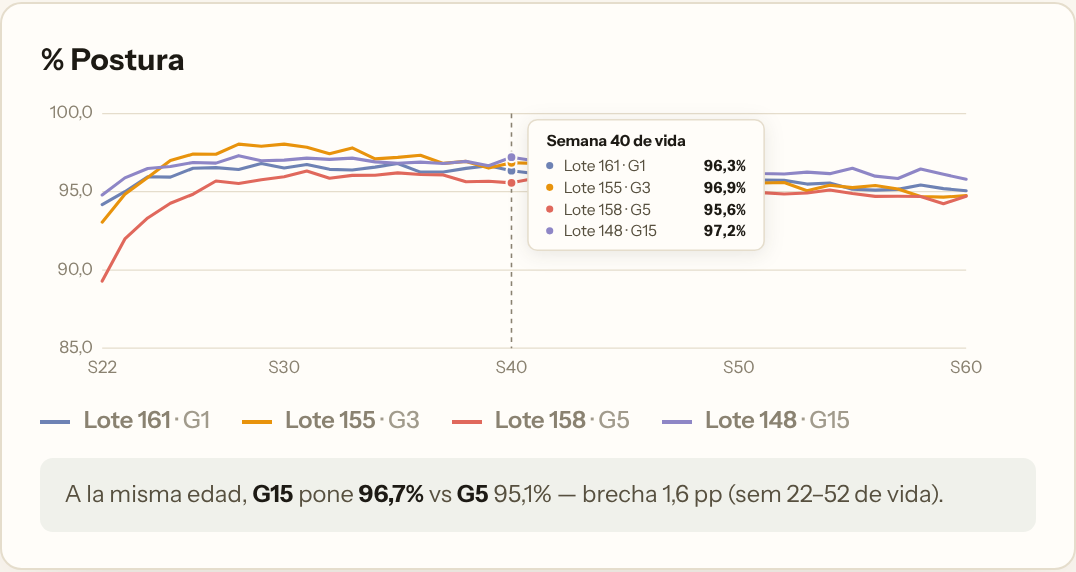
Compare flocks of the same breed at the same age
If two flocks of the same breed, at the same week of age, have different rates of lay, the difference is real and worth investigating: house, feed, health, lighting program, stocking density? With the same age and breed, the obvious explanations are ruled out and you are left with the ones you can fix.
What one percentage point of lay means
One percentage point of lay is one more egg per day for every 100 birds. Over a year that is (birds / 100) × 365 eggs. For 100,000 birds, one point is 365,000 eggs a year. Multiplied by the price per egg, it gives the annual value of that point. On a farm with one million birds, one point is more than 3.6 million eggs a year.
That is why a drop of two or three points that lasts two weeks is already money, even if in the logbook it looks like one off day.
Catching drops in time
- Look daily, not at month end. If the drop shows up in the monthly summary, weeks have already gone by.
- Compare every new data point against the breed curve and the flock's history, not against the previous day.
- Look at rate of lay together with water intake and mortality. A drop in lay usually comes with another signal.
- Set a threshold for deviation from the curve that triggers an alert, and make the alert state the house, flock and exact number.
- Check the data first: a house that stopped sending data looks like a drop. A same-day alert avoids false alarms.
flowkore compares every new data point against the breed curve and the flock's history, and deviations in rate of lay, water intake and mortality trigger alerts by Telegram or email, with house, flock and exact number, plus a daily summary. For the cost of those deviations, see feed cost per egg and feed conversion. To choose a tool, the laying hen software guide.
Frequently asked questions
How do you calculate the rate of lay?
Divide the number of eggs by the live birds and by the days in the period, and multiply by 100. Live birds are the hens housed minus the flock's cumulative mortality.
Why compare by week of age and not by date?
Because egg production follows a curve with the flock's age. Two flocks on the same calendar date can be at completely different stages; at the same week of age and breed, the comparison is valid.
How much is one percentage point of lay worth?
One point is one more egg per day for every 100 birds, that is (birds / 100) × 365 eggs a year. For 100,000 birds that is 365,000 eggs a year; multiply by your price per egg to see the value.
What are hen-housed eggs?
The cumulative eggs divided by the birds housed at the start. It includes the birds that died, so it reflects both the rate of lay and the flock's mortality.
Try it with your own spreadsheets
Want to see this with your own numbers? Free assessment with your spreadsheets: send us the last few weeks' spreadsheets and we will send back your farm loaded in flowkore, with rate of lay vs. standard, mortality and feed conversion. Message us on WhatsApp or write to info@flowkore.com.